Ingenia Therapeutics tops current standard of care for degenerative retinal disease with modified bispecific antibody technology
Optimizing a targeted bispecific antibody to improve expression and binding.
Case Study
Ingenia Therapeutics tops current standard of care for degenerative retinal disease with modified bispecific antibody technology
Executive Summary:
Wet age-related macular degeneration (AMD) and diabetic macular edema (DME) are two leading causes of vision loss, together affecting more than 40 million people globally. Both disease states are driven in part by the upregulation of vascular endothelial growth factor (VEGF) as well as Angiopoietin-2 (Ang2). A recently approved bi-specific antibody targeting Ang2 and VEGF, Faricimab, reduces intersititial retinal fluid and retinal thickness, compared to standard care treatment (Aflibercept).
Despite the advantages of Faricimab, many DME patients do not respond completely to treatment.
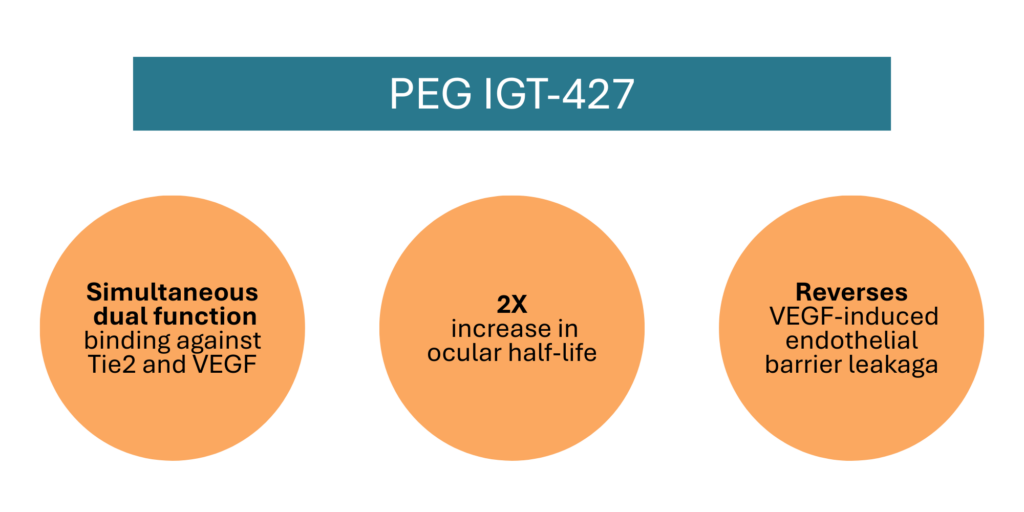
Mosaic and Ingenia generated an improved bispecific pegylated antibody, IGT-427, that has dual function of VEGF inhibition and Tie2 activation. The improved activity of IGT-427 includes direct activation of Tie2 that exceeds Ang2 blockade in vitro, protection against Tie2 downregulation from proteases, and long-lasting half-life in the vitreous. These higher and longer-acting pharmacodynamics, may lead to increased patient response and decreased frequency of administration compared to current standard of care.
Method Highlights
Binding and Functional Assays:IGT-427 binding affinities to VEGF and Tie2 were assessed by SPR analysis (Biacore). Potency and soluble Tie2 assays were carried out in either HUVEC cells or CHO cells overexpressing human Tie2. Endothelial barrier integrity was assessed using a TEER (trans- endothelial electrical resistance) assay with CellZscope® (Nanoanalytics).
Protein Engineering:PEGylated IGT-427 was produced by engineering cysteines near the C-terminus of IGT-427 heavy chain. The two free cysteines in this variant of IGT-427 were reacted with 20 kDa linear or 40 kDa branched PEG-maleimide.
PK Analysis:To assess the ocular PK of IGT-427 and PEGylated variants, total drug levels were measured by ELISA in the vitreous of rabbits after intravitreal injection with 500 μg of aflibercept, faricimab, IGT- 427, 20 kDa linear PEGylated IGT-427, or 40 kDa branched PEGylated IGT-427.
Results
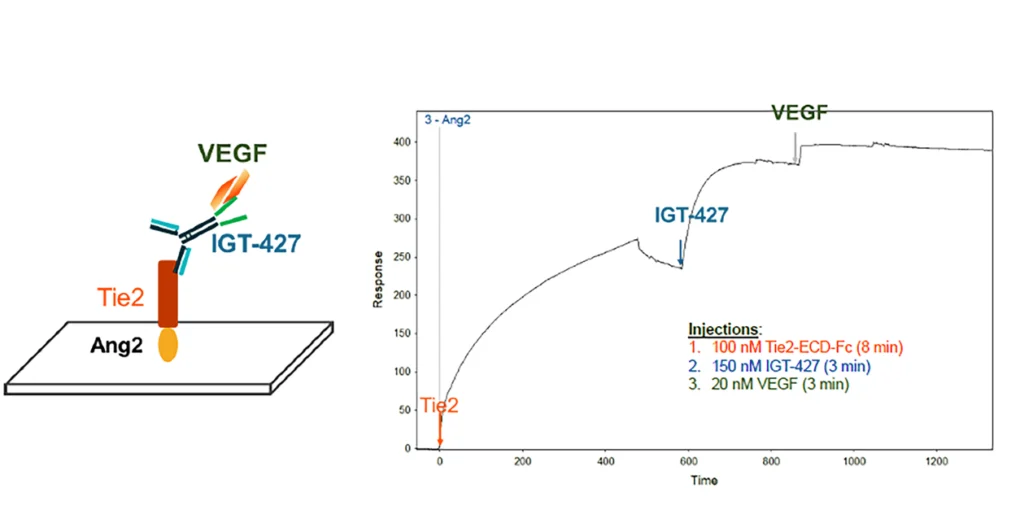
- IGT-427 binds Tie2 and VEGF simultaneously
Details
Surface Plasma Resonance (SPR), Biacore (Ang2 mobilized on a chip and sequential additions of
Tie2-ECD, IGT-427, and VEGF)
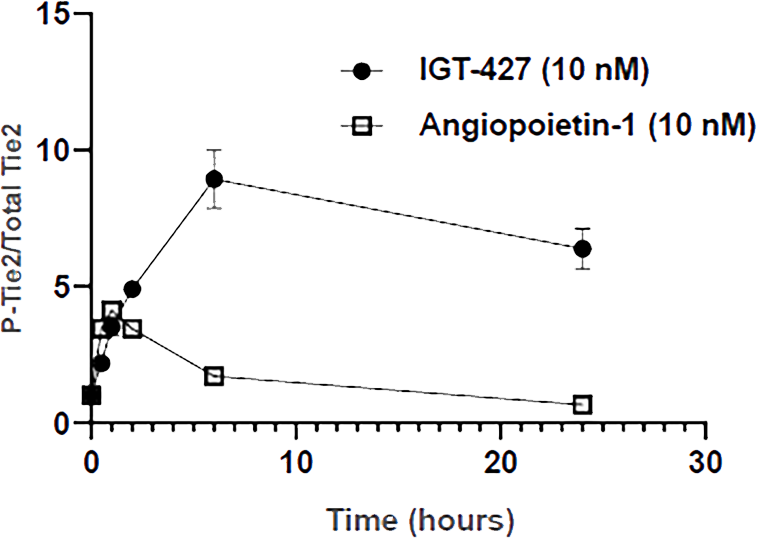
2. IGT-427 induces stronger and more durable activation of Tie2 than endogenous activator, Angiopoietin-1
Request the case study- Ingenia
Speak to a scientist
Connect with our discovery experts to discuss your program and explore how Mosaic can help move your ideas forward.