A New Approach to Long-Acting Intravitreal Biologics
Published: April 27, 2026 | Category: Science, Ophthalmology, Protein Engineering
Frequent intravitreal injections remain one of the biggest barriers to real-world efficacy in retinal medicine. Patients with wet AMD, diabetic macular edema, and dry AMD often face monthly or bi-monthly clinic visits, and when compliance slips, outcomes follow. The science works. The compliance doesn’t.
In a recent webinar, Mosaic CSO Eric Furfine presented Mosaic’s approach to this problem: a protein-based pharmacokinetic enhancer (PKE) designed to extend the vitreous half-life of intravitreal biologics without sacrificing the tissue penetration needed for efficacy.
Why Durability Is the Next Frontier in Retinal Medicine
VEGF blockade transformed the treatment of wet AMD and diabetic macular edema. Drugs like aflibercept and ranibizumab moved the field from irreversible vision loss to meaningful preservation, and in many cases, improvement. But the treatment burden they require is significant, and real-world outcomes consistently lag behind what clinical trials demonstrate. The gap is largely attributable to missed injections.
Reducing injection frequency without compromising efficacy is now one of the field’s most active areas of development. The challenge is that it’s harder than it sounds.
The Problem With Simply Making Molecules Bigger
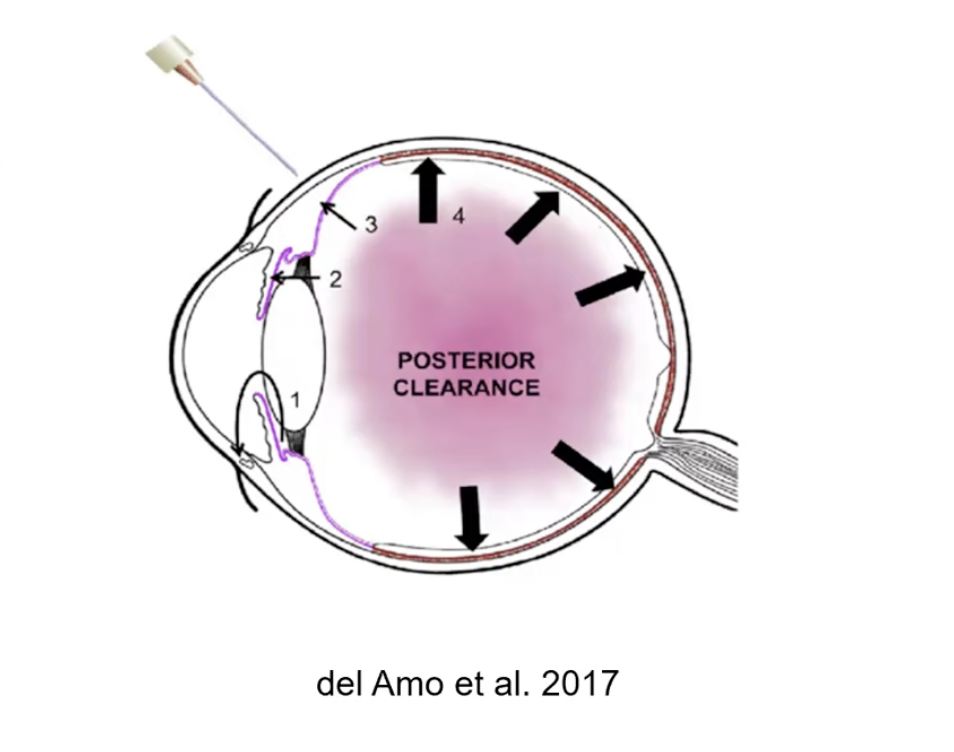
It has been understood for decades that larger molecules clear from the vitreous more slowly than smaller ones. This is part of why antibodies and Fc-fusion proteins outperformed earlier, smaller therapeutic formats in ocular indications, size buys residence time.
The logical extension is to make molecules even larger. Some programs have pursued very high molecular weight conjugates in pursuit of extended durability. The results have been mixed, and the likely reason illustrates the core trade-off: a molecule large enough to slow vitreous clearance significantly may also be too large to penetrate retinal tissue effectively. Extended half-life without adequate tissue access doesn’t translate to better efficacy.
PEGylation offers another route to increasing hydrodynamic radius, and has shown some success. But depending on placement and approach, PEGylation can reduce biological activity, and there are lingering concerns, perception-based or otherwise, around ocular tolerability.
The field needs a way to extend vitreous residence time without paying a tissue penetration penalty. That’s the problem Mosaic set out to solve.
How PKE Works
The key insight behind Mosaic’s PKE platform is that vitreous residence time is governed by hydrodynamic radius, the effective size a molecule presents as it moves through fluid, rather than absolute molecular weight alone. A molecule that coordinates water effectively can behave much larger than its actual mass would suggest.
Mosaic’s PKE peptides are small, intrinsically disordered sequences that are appended to a therapeutic protein. Because they’re floppy rather than structured, they coordinate water in a way that substantially increases the protein’s apparent size in solution, without a proportional increase in actual molecular weight. The result is a molecule that clears from the vitreous more slowly, while remaining compact enough to maintain retinal tissue penetration.
Critically, this approach is designed to be modular. The PKE sequences can, in principle, be appended to a range of therapeutic proteins, antibodies, fusion proteins, and bispecifics, making it a platform rather than a one-off modification.
What Mosaic Has Demonstrated
Mosaic has generated preclinical data using an aflibercept analog as the base molecule, testing multiple PKE configurations. The program is early-stage, but the results across several key parameters, vitreous residence time, retinal tissue penetration, binding activity, and stability, were encouraging enough to motivate continued development and partnership discussions.
The core finding is that the approach achieves what it set out to do: meaningful extension of vitreous half-life with preservation of tissue access and biological activity. The specific data are available in the webinar recording above.
Where the Program Is Headed
Mosaic is actively working to advance the PKE platform and is looking for partners who want to explore applying it to their own retinal programs. Near-term priorities include extending the durability profile further and demonstrating applicability across a broader range of protein formats and targets beyond the VEGF pathway.
For teams working on intravitreal biologics who are facing the injection frequency problem, this is an early-stage opportunity to explore a differentiated approach with low barriers to entry.
About Mosaic Biosciences
Mosaic Biosciences is a biologics drug discovery CRO based in Boulder, Colorado, specializing in end-to-end protein engineering and antibody discovery. Ophthalmology is our largest single therapeutic area by program volume.
To learn more about the PKE platform or discuss a collaboration, contact us.
Speak to a scientist
Connect with our discovery experts to discuss your program and explore how Mosaic can help move your ideas forward.